
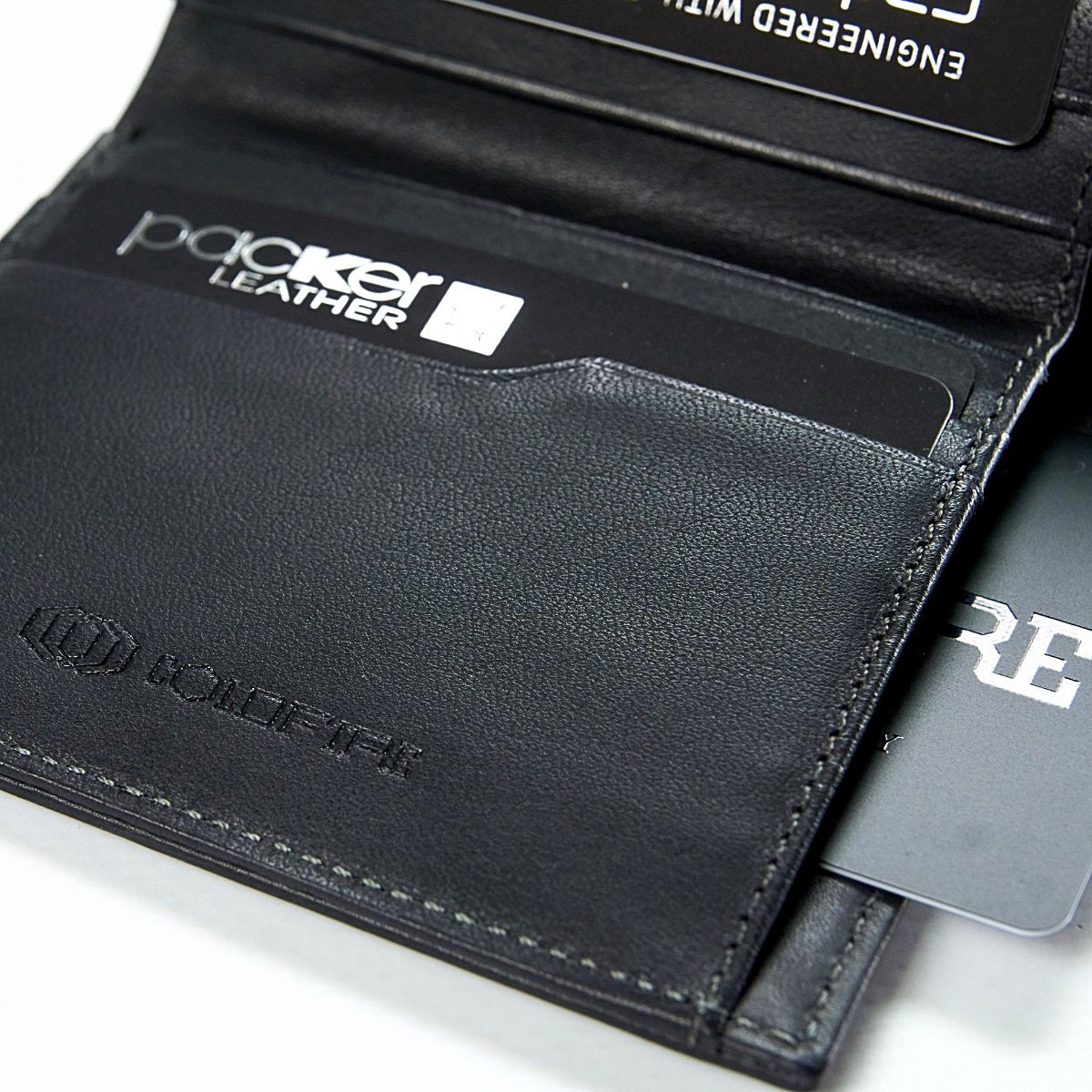
Kangaroo leather is stronger than cowhide at the same thickness, by a wide and well-documented margin. That sentence is true and also not enough to choose a wallet by, because a wallet fails for reasons that tensile strength alone does not predict. This article sets out what the published research actually measured, why the difference exists, where it matters in a wallet and where it does not, and why we laminate kangaroo leather to a carbon fiber shell rather than use it alone. We make wallets from both leathers and have for twenty-five years, so this is written from the cutting table as much as from the literature.

The numbers, with their sources
| Property | Kangaroo leather | Cowhide | Source |
|---|---|---|---|
| Tensile strength at equal thickness | Roughly 10 times cowhide | Baseline | Industry figure from CSIRO-era research; independent maker tests of vegetable-tanned kangaroo report about 4 times (David Morgan) |
| Versus goatskin | About 50 percent stronger | Weaker than goat at equal thickness | Same industry figure |
| Strength kept when split to 20 percent of original thickness | 30 to 60 percent | 1 to 4 percent (calf) | Stephens 1987 |
| Fibre orientation | Uniform bundles parallel to the surface | Complex weave, bundles at up to 90 degrees to the surface | Bavinton et al. 1987, comparative morphology |
| Sweat glands and erector pili muscles | Absent | Present in the upper skin | Same |
| Elastin distribution | Even through the thickness | Concentrated near the grain | Same |
| Typical wallet thickness used | 0.5 to 0.7 mm | 1.0 to 1.4 mm | COLDFIRE production practice |
Three cautions on reading the table. "Ten times" is the figure the Australian kangaroo industry has quoted since the CSIRO Leather Research Centre studies of the 1980s; the primary paper we can point to, Stephens 1987, documents the split-strength figures rather than a single multiplier, and one maker's own tests of vegetable-tanned kangaroo lace found about four times cowhide. The direction is not in dispute; the multiplier depends on tannage, thickness and test method. Second, it is a comparison of tensile strength at equal thickness in laboratory conditions, not a claim that a kangaroo wallet lasts ten times longer. Third, the figures describe the leather, not any particular tannery's output: tanning, finishing and the part of the hide used move every number.
Why the difference exists
Cattle hide is built for a large, slow, thick-skinned animal. Its collagen fibre bundles weave in three dimensions, many of them running at steep angles to the skin surface, around sweat glands, hair erector muscles and a layer of elastin concentrated just under the grain. When a tannery splits that hide to make it thinner, the knife cuts through fibres that were carrying load diagonally, and each cut fibre end is a place where a tear can start. Split cowhide thin enough for a slim wallet and most of the strength is gone.
Kangaroo hide is built for a lighter animal that moves in a different way. Its fibre bundles are remarkably uniform and lie parallel to the surface, there are no sweat glands or erector muscles interrupting them, and the elastin is spread evenly through the thickness. Split it and the knife runs between fibres rather than across them. That is the whole explanation: the strength is in the architecture, and the architecture survives thinning.

What this means inside a wallet
A wallet is thin leather under constant, small, repeated loads: cards pushed in and out, the fold opened and closed, the whole thing compressed in a pocket. The failure that matters most is not tearing, which is rare, but stretching: card slots that loosen until cards slide out, a fold that goes slack. Stretching is resisted by tensile strength at the thickness actually used.
Here the comparison is not theoretical. A cowhide card slot has to be cut from leather around 1.0 to 1.2 mm to hold its width; stack four such slots and a lining and the wallet is 8 to 10 mm thick before a single card goes in. The same slot in kangaroo at 0.6 mm holds its width with more margin, and four of them stack to half the thickness. That is the engineering reason slim wallets exist in kangaroo and struggle in cowhide, and it is why every COLDFIRE wallet uses K-Leather for the card architecture.
Where cowhide still wins, and where kangaroo does not help
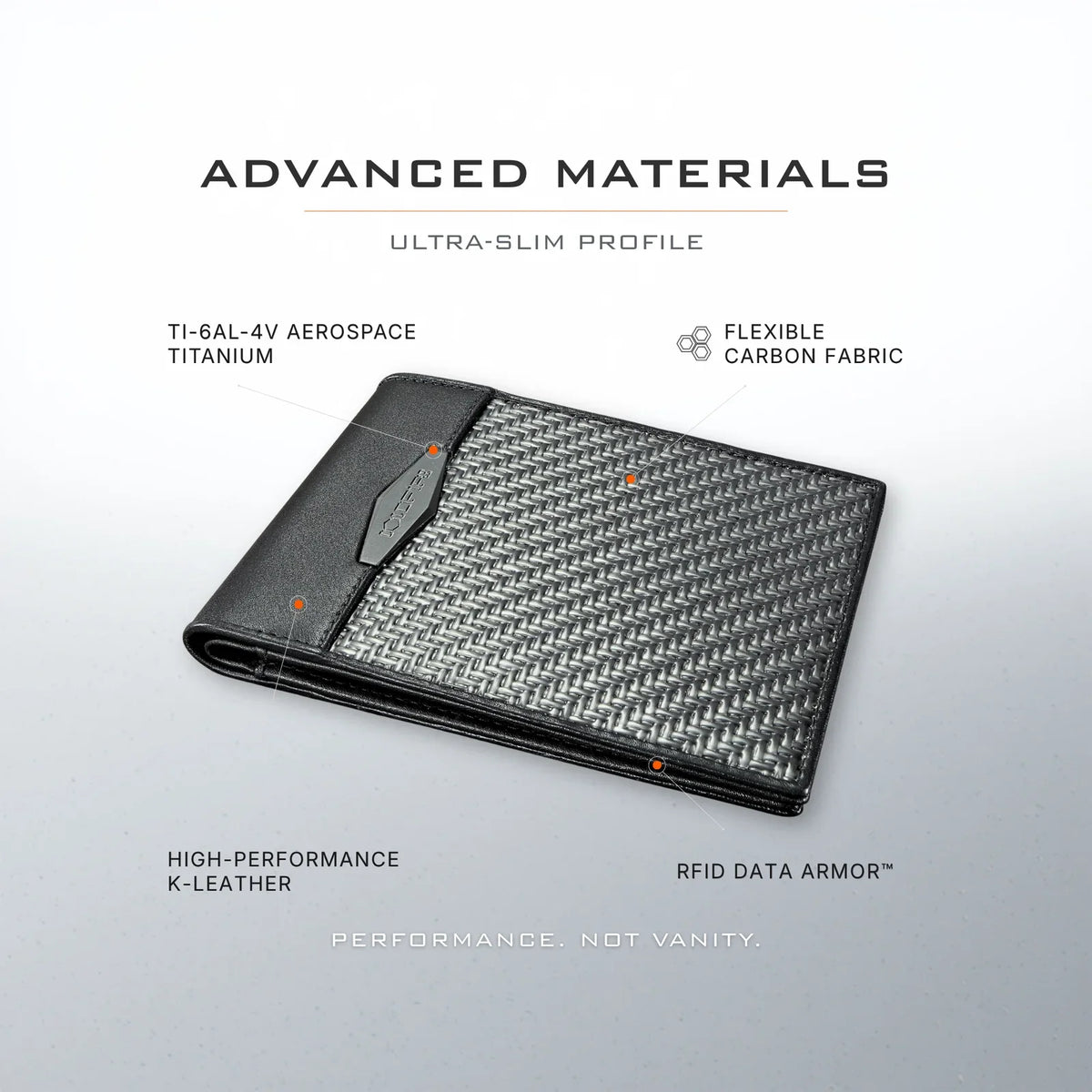
Honesty requires the other column. Thick full-grain cowhide has body: it stands up, holds a shape, and gives a traditional bifold its substance. Thin kangaroo alone does not. A wallet made only of 0.6 mm kangaroo would be strong and floppy at the same time, which is why we do not make one. We laminate the kangaroo to a Carbitex OmniFlex flexible carbon fiber shell: the carbon provides the structure and shape retention, the kangaroo provides strength at the slots and a leather surface that wears in rather than out. Each material does the job the other cannot.
Kangaroo's fine, tight grain also shows surface scuffs sooner than a pebbled or heavily finished cowhide. The scuffs are cosmetic and do not reduce strength, but a buyer who wants a leather that hides handling marks should know this. And none of the numbers above speak to the parts that actually end most wallets' lives: thread, lining and edge finish. A kangaroo wallet sewn with plain polyester thread and lined with blade-cut nylon will fray and open at the seams like any other. We covered those failure points in How Long Does a Wallet Last and Wallet Linings Compared.

Supply, and why the tannery matters
Kangaroo leather is not a commodity in the way cowhide is. It comes from Australia's regulated kangaroo harvest, managed by state wildlife authorities with annual quotas, and the hides are processed by a small number of specialist tanneries. The tannery decides the finish, the consistency between hides, and whether the leather's natural strength survives the process. COLDFIRE's K-Leather is tanned by Packer Leather in Queensland, in business since 1891, named International Tannery of the Year in 2014, a Leather Working Group member, sourcing through the Kangaroo Industry Association of Australia. We name them because a claim about kangaroo leather is only as good as the tannery behind it.
One legal note for readers in the United States. Kangaroo leather is legal to import and sell at federal level, and across the European Union, the United Kingdom and Australia, where the harvest is regulated by state wildlife authorities under annual quotas. The exception is California, where Penal Code section 653o prohibits importing kangaroo products into the state for commercial purposes, possessing them with intent to sell, and selling them within the state; the penalty falls on the seller. The law dates from the 1970s, lapsed briefly in 2007 to 2015 and has been in force since 2016. It is the reason several sports brands have moved away from kangaroo leather in football boots. Buyers in other states and countries are not affected.
- Leather
- K-Leather kangaroo, Packer Leather, Queensland, Australia
- Thickness in COLDFIRE wallets
- 0.5 to 0.7 mm, split and skived in-house
- Structural partner
- Carbitex OmniFlex (CX6) flexible carbon fiber shell
- Thread
- AMANN Strongbond bonded polyamide, OEKO-TEX Standard 100
- Lining
- Dyneema ripstop, laser-cut
- Guarantee
- Five years against stretching, swelling and loss of shape within stated capacity
Every material is named with its maker on the Engineering and Quality page. The wallets built this way are the Flex and Strike series.
Questions, answered
Is kangaroo leather stronger than cowhide?
At equal thickness, yes. The figure quoted across the Australian industry, from CSIRO-era research, is roughly ten times the tensile strength of cowhide of the same thickness and about 50 percent stronger than goatskin; independent maker tests of vegetable-tanned kangaroo found about four times. The difference comes from fibre structure, not from the animal being tougher: kangaroo collagen fibres run parallel to the skin surface in uniform bundles, cattle fibres cross it at angles.
Why does kangaroo leather stay strong when it is split thin?
Because splitting cuts across fewer load-bearing fibres. When cowhide is split to 20 percent of its original thickness it keeps only 1 to 4 percent of its tensile strength; kangaroo split the same way keeps 30 to 60 percent. That is why kangaroo can be used at 0.5 to 0.7 mm in a wallet where cowhide would need 1.0 to 1.2 mm for similar strength.
Does a kangaroo leather wallet last longer than a cowhide one?
Not automatically. Tensile strength decides whether card slots stretch, and there kangaroo wins clearly. Abrasion resistance, surface finish, thread, lining and construction decide the rest, and a well-made full-grain cowhide wallet beats a badly made kangaroo one. Kangaroo gives the designer strength at low thickness; what is done with it is the rest of the story.
What are the weaknesses of kangaroo leather?
Three honest ones. It has less body than thick cowhide, so a wallet made only of thin kangaroo can feel floppy unless it is paired with a structural layer; COLDFIRE pairs it with a carbon fiber shell for this reason. Its fine, tight grain shows scuffs more readily than a pebbled cowhide, though they do not weaken it. And it costs more and comes from a regulated Australian supply, so the choice of tannery matters.
Where does COLDFIRE's kangaroo leather come from?
From Packer Leather in Queensland, Australia, tanning since 1891 and International Tannery of the Year 2014. Packer is a Leather Working Group member and sources hides through Australia's regulated kangaroo industry, represented by the Kangaroo Industry Association of Australia.
Is kangaroo leather the same as K-Leather?
Yes. K-Leather is the trade name under which kangaroo leather is sold in performance applications such as football boots and motorcycle suits, and the name COLDFIRE uses for the Packer Leather kangaroo hide in its wallets.
Is kangaroo leather legal?
Yes, in most of the world. Kangaroo leather is legal to import and sell in the United States at federal level, in the European Union, the United Kingdom and Australia, where the harvest is regulated by state wildlife authorities under annual quotas. The exception is California: Penal Code section 653o prohibits the commercial import, possession for sale and sale of kangaroo products within the state, with the penalty falling on the seller. The law has been in force since 2016 after a lapse between 2007 and 2015, and it is why several sports brands stopped using kangaroo leather in football boots.
Sources
- Stephens, L. J. (1987). Stratigraphic analysis of kangaroo leather. Journal of the American Leather Chemists Association, 82(2), 41 to 44.
- Bavinton, J. H. et al. (1987). A comparative morphology of kangaroo and bovine leather. Journal of the American Leather Chemists Association, 82.
- Looney, M., Kyratzis, I., Truong, Y. and Wassenberg, J. (2002). Enhancing the Unique Properties of Kangaroo Leather. RIRDC Publication No. 02/105, Rural Industries Research and Development Corporation, Australia. AgriFutures Australia; full text.
- Packer Leather, Queensland: kangaroo leather properties and tannery documentation supplied to COLDFIRE.
- California Penal Code section 653o, text as in force (verified October 2026).
- David Morgan, Seattle: Comparative Characteristics of Kangaroo Leather, maker tests of vegetable-tanned kangaroo versus cowhide and deerskin.
Written by Todor Georgiev, founder of COLDFIRE and a leather goods manufacturer in Plovdiv since 2000. Published 1 November 2026. Laboratory figures are quoted from the sources above; thickness and construction figures are COLDFIRE production values.

Сподели:
Gifts for Engineers and EDC People: 12 Things They Will Actually Keep (2026)
How Long Does a Wallet Last? Wallet Materials Ranked by Lifespan